
CHEAPER THAN CHEEP - A TOKEN OF HIS EXTREME: TV SHOWS
 In 1974 a video was made of a live performance at KCET studios, combined with clay animations by Bruce Bickford (image to the right). The intention was to have it broadcast by tv stations, which succeeded in France
and Switzerland. In the 1980s material form this video got included in "The dub room special" video, that he distributed himself. It's a combination
of footage from a 1974 concert and the 1981 "You are what you is" MTV-concert, augmented with interviews and
the clay animations by Bruce Bickford. Bootlegs from the tv broadcasts circulated as "A token of his extreme", the title given by Zappa himself.
In 2013 the ZFT released the original video in its entirity.
In 1974 a video was made of a live performance at KCET studios, combined with clay animations by Bruce Bickford (image to the right). The intention was to have it broadcast by tv stations, which succeeded in France
and Switzerland. In the 1980s material form this video got included in "The dub room special" video, that he distributed himself. It's a combination
of footage from a 1974 concert and the 1981 "You are what you is" MTV-concert, augmented with interviews and
the clay animations by Bruce Bickford. Bootlegs from the tv broadcasts circulated as "A token of his extreme", the title given by Zappa himself.
In 2013 the ZFT released the original video in its entirity.
The KCET show took place two months after an earlier attempt at the Mothers of Inventian rehearsal area at the Discreet offices building. As at the Roxy
concerts problems arose with getting the film and music synchronous, so it had to be done again. The ZFT/UMG solved the problems with the Roxy movie
and decided to do the same with this project. The existance of the event got little attention, but gets described in the biography by Román García Albertos on page 392:
"What got filmed during the Roxy concerts remained unusable for the moment, so, before leaving Los Angeles for another tour, Zappa organized a private concert
on june 21 1974 in the rehearsal hall of the Discreet company, in order to film a video for a possible TV special [...]. For some reason Zappa never published
any footage or music from this recording. Only three photos on the inside cover of the Roxy & Elsewhere album." So with the 2025 ZFT/UMG "Cheaper than cheep" edition
we know the reason and we can watch and listen to material that, in an edited form, was intended for release. The title comes from Zappa's introduction to
the concert filming calling the manner it was done cheaper than cheap. The ZFT/UMG toyed with these words spelling it as "cheep" (bird sounds).
RDNZL (1974)
The band started playing "RDNZL (1972-8)" in 1972, but it would take till 1978 for this song to appear on record. See the Studio tan
section for an analysis how this song developed through the years. The "RDNZL" version, that you can hear on "Cheaper than cheep", goes comparible to the one
on "YCDTOSA Vol. II". The big difference lies in the tempo the main theme is played with. On "YCDTOSA Vol. II" the section from below can be heard between 0:17 and 0:46.
RDNZL, 0:19-0:36 (midi file).
RDNZL, 0:19-0:36 (transcription).
Zappa originally composed "RDNZL" with an opening in 3/4. In 1974 the tempo got thus high that Zappa doesn't begin with counting one or two meters as one-two-three, but whole meters
as one-one-one-one. On "Cheaper than cheep" this fast tempo simply gets maintained for the main theme. Because of the tempo I've notated the example from above in 3/8 instead of 3/4.
The bass pattern in bars 1-3 comes from the original 1972 score, returning in bars 9-11 and 25-27.
RDNZL, 4:16-4:46 (midi file).
RDNZL, 4:16-4:46 (transcription).
When you're comparing the 1974 execution with the one from 1972 on "The lost episodes" you can notice that the main theme from above got added later on. This goes for more passages,
while the way the band is soloing also changed over time. The second example from above contains:
- Bars 1-5: last repitition of a sung theme ("We could share a love"), not present in the 1972 score. It's a slow theme in D Dorian,
that I've notated in 12/4 in this context. Staff 1 of bar 2 contains comments by Napoleon Murphy Brock, deliberately spoken that fast that it becomes unintellegible.
- Bars 6-9: switch to F Mixolydian in 17/16. George Duke repeats a figure on keyboards. Thanks to Joe Travers for informing us about the meter in the CD booklet (2/4 plus 9/16, 17/16 in total). Ruth Underwood adds: "that's a lot of math, but they made it swing!!". There many examples of Zappa applying odd-numbered meters. In case of "Don't eat the yellow snow" it's 7/8, with a tempo takes makes counting through it easy: One-two-One-two-One-two-three. In this case the tempo is thus high, that trying to count or tick 16th notes along with it becomes
difficult. So the help of Joe Travers comes in handy.
- Bars 10-13: standard playing as a transition towards the keyboard solo.
- Bars 14-18: beginning of the keyboard solo. The bass plays a 4-bar movement G-F-E-F with the key becoming G minor. The 17/16 meter gets continued.
It makes it sound more jazzy like this, as if there's a tiny little pause at the end of each bar. Also the playing of the Gm7 chord in bar 12 is jazz-like, just behind the downbeat.


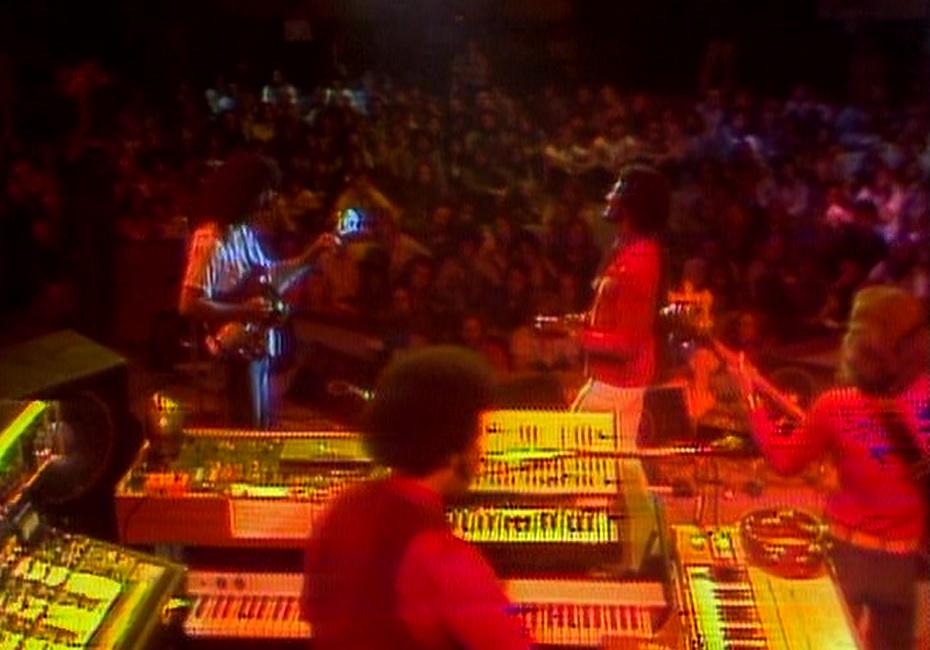
Two stills from "Cheaper than cheep" with the band playing "RDNZL".
I don't even care (1974)
"I don't even care" got released first on the "FZ meets the Mothers of prevention" from 1985, but the idea for this song goes back to 1974. It has the band improvising around a sung vamp. Because of that, none from the example below could be transcribed with much precision.
I don't even care, 0:58-1:13 (midi file).
I don't even care, 0:58-1:13 (transcription).
In 1974 this vamp consisted of four bars as shown in bars 1-4 from the example,
the last time it can be heard towards the end. Bars 1-3 are in G Dorian. The figure from bar 4 isn't present in the 1985 version.
Bars 5-6 contain a new figure, that gets repeated till the end as a coda. It's in D Dorian/Mixolydian with the F# and F being used next to each other.
Get down Simmons
"Get down Simmons" is a collage piece. At the beginning and at the end you can hear little composed and improvised blocks for the band. In between
Jeff Simmons gets encouraged to play in Bb. He and the band indeed begin with a Bb major triad, but soon turn over to playing a blues lick in Bb Dorian,
in the manner of "Mannish boy" (see also "For Duane" from the Guitar section).
Get down Simmons, 0:00-0:17 (midi file).
Get down Simmons, 0:00-0:17 (transcription).
The example from above is from the opening, containing:
- Bar 1: four fast beats with the notes jumping up and down.
- Bar 2: a string of notes. Because of the tempo, you can't really distinguish the individual notes. When transcribing it, you can listen to split seconds
over and over and get it on paper.
- Bars 3-4: a single note, followed by pausing.
- Bars 5: the figure from bar 1 returns, now played half-speed. The notes in it aren't identical, but it goes comparable.
- Bar 6: because of the lesser tempo, a melody can now be followed without problems.
- Bars 7-8: some more notes followed by pausing.
- "Bars" 9-12: the band now starts to improvise without a meter. Ruth Underwood plays some rapid notes over a synthesizer bass drone. Next Napoleon Murphy Brock
plays a sustained fluctuating note. It has an electronic effect over it to let it sound as if it is echoing. This gets followed by Chester Thompson soloing
shortly etc. The transcription stops at this point.
Wowie Zowie (1974)
 The 1974 spring tour was the Mothers of Invention 10th anniversary tour. Because of that the band returned to playing a dozen of older songs,
at least seven of them coming from "Freak out!". None of these 1974 performances of these songs are available in Zappa's own
catalogue, but when the Cheaper than cheap project would have succeeded some might have been included. Normally most of a concert consisted of recent material.
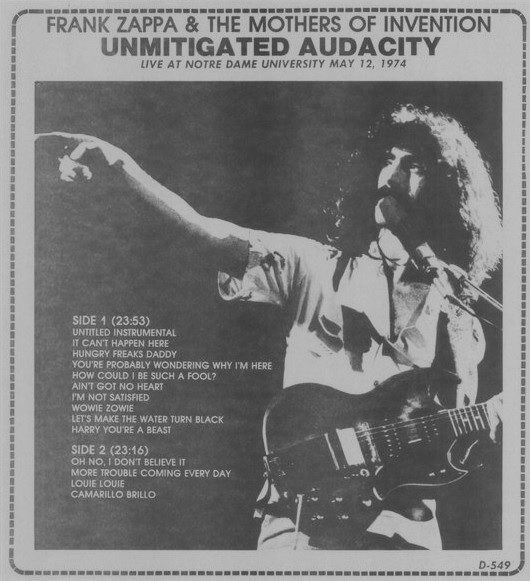
To the right an image of the "Unmitigated audacity" bootleg, that got included in the "Beat the boots" series, having these "Freak out!" songs on it.
The sound quality of this bootleg is thus dim, that it does little more than documenting the band played these songs. It stems from the Notre Dame University
concert, May 12, 1974, South Bend. The tapes of this concert are present in the Vault, with two tracks being released on the ZFT release "Zappa/Erie".
Joe Travers notes: "Frank mixed a 13-minute chunck of music from the Notre Dame 4-track masters with Kerry McNabb at Paramount Studios, most likely in early 1974 while
off the road. In the future we could have a full release of both nighs for a Mother's Day release". The other night would be the Chicago concert, May 11, 1974,
apparently belonging to the little that has been kept in the Vault of this spring tour.
The 1974 spring tour was the Mothers of Invention 10th anniversary tour. Because of that the band returned to playing a dozen of older songs,
at least seven of them coming from "Freak out!". None of these 1974 performances of these songs are available in Zappa's own
catalogue, but when the Cheaper than cheap project would have succeeded some might have been included. Normally most of a concert consisted of recent material.
To the right an image of the "Unmitigated audacity" bootleg, that got included in the "Beat the boots" series, having these "Freak out!" songs on it.
The sound quality of this bootleg is thus dim, that it does little more than documenting the band played these songs. It stems from the Notre Dame University
concert, May 12, 1974, South Bend. The tapes of this concert are present in the Vault, with two tracks being released on the ZFT release "Zappa/Erie".
Joe Travers notes: "Frank mixed a 13-minute chunck of music from the Notre Dame 4-track masters with Kerry McNabb at Paramount Studios, most likely in early 1974 while
off the road. In the future we could have a full release of both nighs for a Mother's Day release". The other night would be the Chicago concert, May 11, 1974,
apparently belonging to the little that has been kept in the Vault of this spring tour.
Wowie Zowie, 0:00-0:21 (midi file).
Wowie Zowie, 0:00-0:21 (transcription).
"Wowie Zowie" is one of the songs coming from "Freak out!", now available via "Cheaper than cheep".
Its structure has been kept the same, but at a detail level a lot goes different. See the Freak out section for an example
from "Wowie Zowie (1966)". The example from above contains the instrumental opening from 1974:
- Bars 1-3: guitar progressions in G Mixolydian, that is that's how it sounds at this moment, being I-II-I in bar 1, II-VI-VII-I in bar 2, and just I in bar 3.
- Bars 4-6: a melody of one bar in C, played via parallels, repeated twice.
- Bars 7-9: bars 1-3 return.
Next the sung part begins with the accompaniment going in a way comparable to bars 4-6. C can thus be seen as the central key. Retrospectively the G chord from
bars 1-3 might than be considered to be step V of C.
Wowie Zowie, 1:39-1:53 (midi file).
Wowie Zowie, 1:39-1:53 (transcription).
Towards the end the band begins with playing a bit of lounge music. When playing bars 1-5 from the second example from above them by themselves, one wouldn't recognize
them as belonging to "Wowie Zowie". In fact one wouldn't associate it with anything the Mothers ever played. It's fun still to be able to encounter
such side-steps from the archive material. Only in bar 6, when the lyrics starts, the connection becomes clear. Staff one is a syncopic I-V chord alternation in C.
The bass plays along the line C-A-D-G, while other instruments are giving some harmonic fill-in. So the overall harmony is wider than I and V.
Let's make the water turn black (1974)
"Let's make the water turn black (1968)" was released
first on "We're only in it for the money". Its score is included in the FZ Songbook Vol. I. See the corresponding section for an example.
Half of the 1974 performance is newly composed. At first a couple of bars, but starting at 2:03, all of it. The part of it with lyrics ends
with singing over a vamp. Next this vamp gets continued instrumentally with Zappa playing a guitar solo.
Let's make the water turn black, 2:52-3:22 (midi file).
Let's make the water turn black, 2:52-3:22 (transcription).
It's a two-bar vamp with an E-Bb-E-Bb-E-C-E-C progression, with Ruth Underwood playing a melody over it on marimba. Of the seven possible standard diatonic
scales, harmony books usually only mention Phrygian and Locrian briefly for matter of completeness. Both start with a minor second, and, on top of that, the Locrian scale has a tritone
upon its tonic, which makes them less fit for Western music. Especially Locrian is seldom used. In Zappa's music Phrygian is relatively normal and instances
of Locrian can be found, though also in his output Locrian remains rare. See the Burnt weeny section for a table of scales, based upon the examples from this study.
The 1974 version of "Let's make the water turn black" is of interest, being a more extensive use of Locrian, E Locrian in this case. It also
accentuates, rather than avoids the "dissonances" of the Locrian scale: Ruth Underwood begins her melody with an F over E, a minor second, and the bass first
goes from E to Bb, the tritone interval. Zappa fans may recognize a light similarity between this vamp and a I-II alternation in Bb Lydian, a far more common progression
in Zappa's music. At some points (bar 8) it even sounds as if the solo might move over to that progression.
In harmony books a tritone is considered dissonant or unstable. Sometimes it has been nick-named "the devil in music", because it's right in between a fourth and a fifth,
the most consonant intervals. In this case Zappa lets it move over towards a minor sixth in the second bar of the vamp. Wolfgang Ludwig has investiged the use of intervals
in Zappa's melodies, that I'm reproducing in the Zoot allures section. A tritone doesn't rank high, but it's occurrence can be considered normal. In the
context of his Lydian theory Brett Clement came up with a tritone restriction, discussed elsewhere in this study.
I'm not satisfied (1974)
"I'm not satisfied (1966)" is one of the songs that got included in the Frank Zappa Songbook vol. I in a
piano arrangement by Ian Underwood. It doesn't go identical to how it's played on "Freak out!". In the corresponding section I'm mentioning some details, where
I've also included some bars from Zappa's own score. On "Cruising with Ruben & The Jets" this song returned in a doo-wop version. In its original shape the band returned to playing this song during the 1974-5 tours. As usual many details go different. It opens with playing the chords on guitar (bars 1-4), making it sound as a rock version of this song.
I'm not satisfied, 0:00-0:16 (midi file).
I'm not satisfied, 0:00-0:16 (transcription).
In this case you can see that a number of specific elements from the Songbook accompaniment are now used by the band too:
- Example above: marima/keyboard part from bars 5-6.
- Example below: bas line from bars 1-4 and the arpeggio-like figures Ruth Underwood is playing during bars 9-12. She plays them freely, thus not following the specific notes
from the Songbook.
I'm not satisfied, 1:32-2:14 (midi file).
I'm not satisfied, 1:32-2:14 (transcription).
But there are also elements that are specific for this 1974 version on "Cheaper than cheep". In the Songbook, for instance, the line "I just wished that ..."
is song on beat in 4/4 in a standard way. Here Napoleon Murphy Brock begins this line off-beat, continuing in a speech-influenced manner.
While the opening modulates a couple of times, this instrumental end is stable in E Mixolydian (bars 9-10 return to the opening bars in E mixolydian). The only exceptions
are bars 8 and 16 where the start of a chord sequence from the preceding bars gets transposed chromatically:
- Bars 5-7 and 13-15: Bm-C#m-D-C#m-Bm.
- Bars 8 and 16: Dm-Em-F-G-F(-G).
Rhythmically these bars have 3-3-3-3-4 as subdivision.
I'm not satisfied, Songbook, end (midi file).
I'm not satisfied, Songbook, end (notes).
The 1966 and 1974 version, as well as the Songbook arrangement from 1969, let this song end with an instrumental coda. All three version go different.
The Songbook follows "Freak out!", but harmonizes it somewhat differently, and, of course, for a piano the voicing of these chords goes different.
It's interesting hearing this version as a midi file too. After all, it's an officially published version. The 1974 rendition is played yet again in a different manner.
In particular bars 17-21 from my second example from above got added to it. It's playing along and ending on an A major triad, evading from the E Mixolydian key.
Inca roads (1974)
In the liner notes of "One size fits all" Zappa notes: "The basic tracks for Inca roads and Florentine Pogen were recorded live at KCET TV Los Angeles
during the production of our TV special. The guitar solo in "Inca roads" was recorded live during our 1974 concert in Helsinki, Finland".
See the One size fits all section for the guitar solo from Helsinki.
Inca roads (KCET), 2:00-2:34 (midi file).
Inca roads (KCET), 2:00-2:34 (transcription).
On "A token of my extreme" you can hear the KCET recording in full including the guitar solo as played at that specific concert.
The example above is the opening of it. It starts with Zappa and George Duke interacting, a sort of duet for guitar and keyboard.
During these bars the bass is playing around a C pedal, adding various figures to it when the solo is progressing. At 2:57 you can for instance hear the I-II alternation, that would become the standard accompaniment for "Inca road" solos as they appeared on CD since the Helsinki concert. Apparently this wasn't so from the beginning, for both during the Edinboro concert from may 1974 and on "Cheaper that cheep" (CTC) you can also hear a different type of accompaniment.
Inca roads (CTC), 1:15-1:49 (midi file).
Inca roads (CTC), 1:15-1:49 (transcription).
On "Cheaper that cheep" Zappa opens this song with explaining: "So we're gonna start out with a song that deals with vehicles coming to this planet from outer space a long time ago and people in those vehicles maybe getting out of the vehicles and carving some ruts on the top of a mountain so that the other guys into some other vehicles when they came later could see what was going on. And George will tell you all about it. The name of this song is "Inca Roads." Here we go, and don't fuck up the introduction!". In the
One size fits all section I'm discussing the background harmonies that you can hear during the opening theme, leading to the conclusion that the scale
can switch between C and C Lydian. On "Cheaper that cheep" these harmonies are better audible, so I wrote them out in detail in the second example from above.
Also here you can see that the F and F# are used next to each other. In bar 11 you can hear Ruth Underwood following George Duke by opening the vamp on F# for a change.
So the conclusion remains the same.
Inca roads (CTC), 2:53-3:11 (midi file).
Inca roads (CTC), 2:53-3:11 (transcription).
This third example is how the guitar solo on "Cheaper that cheep" starts. The figure from bars 1-2 gets played slightly different on each occasion. In this case it's the bass playing
a melody rather than the staccato-like notes. It goes down from C# to B to A. When the solo starts you can hear the bass playing the opening vamp again, as during the Edinboro
concert. In this case Ruth Underwood keeps repeating the marimba melody from bars 1-2 over the vamp. Zappa begins with just sustaining an F# at first, next playing
around this F# in bar 6-7 till he gets at his more regular playing in bar 8.
About this marimba figure Ruth Underwood is commenting in the CD booklet: "I found this version particularly satisfying. FZ had extracted a musical phrase from his composed theme. After fulfilling its written purpose, it repeated through much of the song. I was so taken with the ostinato's effect, that I wondered why FZ removed it from other
performances [...] As the music became more rhythmically complex, Chester saved me from free fall when I rushed the ostinato figure. He held me in check during FZ's solo, by
emphasizing the two notes at the end of each repeated phrase".
Inca roads (CTC), 8:22-8:52 (midi file).
Inca roads (CTC), 8:22-8:52 (transcription).
The example here above contains the end of the keyboard solo, followed by the beginning of the interlude for marimba. The keyboard bars are alternating two scales:
- Bars 1-4: the whole keyboard solo is in 7/16. At this point the G Dorian scale is followed.
- Bars 5-8: Ab Lydian.
- Bars 9-12: chord progression in G Dorian: Gm7 - Bbm-5 - Am7.
- Bars 13-16: progression in Ab Lydian: Ab-add2 - Gm7 -Ab.
- Bars 17-20: as bars 9-12.
- Bars 21-24: start of the marimba interlude. This can be seen as polyscalar or chromatic. It doesn't go identical to how it's presented in the One size fits all
guitar book, page 34, so I've included another example below. This marimba interlude is a faster variation upon the synthesizer interlude that you can find on page 26 of
the guitar book (there indicated as "synthesizer solo").
Inca roads (One size fits all), 7:47-7:55 (midi file).
Inca roads (One size fits all), 7:47-7:55 (transcription).
In the Hal Leonard series the improvised parts don't get transcribed unless it's Zappa himself on guitar. Addi Booth made an exception for including
the lead melody of George Duke's keyboard solo from "Inca roads", as well as the overdubbed synthesizer parts. The bass and chords combinations are indicated by
chord symbols. This last example begins with the last four bars from the keyboard solo, where the chords dominate. Addi Booth has notated
the marimba interlude in 4/4 using septuplets. By itself that would only be a notational difference with two times 7/16 or four times 7/32, but without a tempo
change, one bar in 4/4 lasts an eighth note longer than the preceding two bars in 7/16. I don't manage to discern that happening on the album, so I'm continuing
with notating in 7/16. As it comes to the details of the marimba melody I'm hearing things a little different, but the tempo of the marimba interlude is thus high that transcribing it with precision becomes difficult and a degree of freedom in how to play it becomes logical. When transcribing something you can listen to split seconds over and over,
but when listening to it normally noboby will notice the minor differences between the examples from above. Ruth Underwood plays this in comparable ways
and, as said, it's a variation upon an earlier section, so it must have been written out by Zappa. Thus far I haven't encountered copies of the original scores from "One size fits all" titles, but their existance has been confirmed by Steve Vai as it comes to "Andy" (see the One size fits all part for the citation).


Opening of the keyboard solo from "Inca roads" as transcribed by Addi Booth, One size fits all Guitar book, pages 28-9.
Florentine Pogen solo (KCET, 1974)
This title got released first on "One size fits all" with the basic tracks coming from this KCET concert. See the corresponding section for a couple of examples from
"Florentine Pogen (1974-5)".
In that chapter you can also find an early recording from march 1974, included in the 2024 ZFT/UMG release "Apostrophe (') 50th anniversary".
At that time this song got played much faster.
Florentine Pogen, 8:51-9:28 (midi file).
Florentine Pogen, 8:51-9:28 (transcription).
Like the march recording, and edited out on "One size fits all", the KCET version knows a solo section. In this case it's a guitar solo, ending with a composed part,
most of it being shown in the example from above. Nominally this section is in A Dorian, the key also used during the soloing itself.
Bars 1-4 contain a figure that gets repeated a couple of times on the DVD with the example including the last two repetitions.
Bars 1-2 sound peculiar because Zappa is inserting an accentuated additional note to the harmonies, an Eb, not belonging to A Dorian. In bars 3-4
we're back in a normal diatonic A Dorian environment. Bars 9-15 contain a sequence with the bass moving chromatically downwards from A to A.
Only at the end in bar 15 we're back at A Dorian, in between it fluctuates. The example stops at this point. The band continues to improvise ad lib,
till Zappa plays the "Chester's gorilla" motif once more in the shape of a coda.
"A token of his extreme" was also released as a soundtrack CD, official release #97. The CD version of "Florentine Pogen" lasts 11 minutes, while
the one on the DVD lasts 10 minutes, so Zappa edited out a minute from the solo. There are more of such differences between the CD and DVD, as there
are also differences between the versions of these songs on "A token of his extreme" and on "The dub room special".

The gorilla from the "Chester's gorilla" line from the lyrics appearing on stage (A token of his extreme video).
More trouble every day solo (KCET, 1974)
The lyrics from "More trouble every day" come from "Trouble every day" from 1965/6. During the 1974 tour the band played this song with newly composed music as in
"More trouble every day (1974)" from "Roxy and elsewhere". Like this it returned during the 1984 and 1988 tours.
Examples from these three tours are present in this study. When played in this manner, the song always included a guitar solo. These solos can make live compilations
of interest, also when the composed part of songs goes the same as earlier releases. When you play the example from below by itself, you wouldn't know
it comes from "More trouble every day". Towards the end it also has characteristics of its own, untypical of Zappa's guitar solos.
More trouble every day, 6:28-7:01 (midi file).
More trouble every day, 6:28-7:01 (transcription).
In case of the KCET concert it ended with playing chord progressions. I guess it's still mostly improvised,
but the outlines must have been prepared during rehearsals. The example contains:
- Bars 1-4: like all "More trouble every day" solos, it's a pedal note solo in Dorian, F# Dorian in all examples from this study. At this point the bass alters F# and E as
eighth notes.
- Bars 5-12: Zappa begins playing chord progressions with the bass playing more melodically. In bar 7 the parallel playing of minor triads causes the C/C# to switch
between sharp and natural, something Zappa does more often.
- Bars 13-17: a second chord progression with the rhythm changing, having the accent on applying dotted quarter notes. Bar 16 contains an argeggio-like chord in normal 4/4.
With bar 17 Zappa continues with dotted quarter notes, with the band beginning to follow his rhythm till the end. The volume of the keyboard is becoming louder, starting
some sort of duet with Zappa's chords. Napoleon Murphy Brock is singing in the background, while also a synthesizer can be heard.
Montana (1974)
The band kept playing this title live frequently since 1972. In the Overnite sensation section you can find a couple of examples
from the 1973 studio version of "Montana". The written part never changed. Nevertheless
the element of improvisation can cause many detail differences. Below I've added the first four corresponding bars from the Overnite sensation
Guitar book below my transcription of a section from the KCET version of this song. When you only take a glimpse at it, it even looks that
it's about different songs.
Montana, 1:20-2:01 (midi file).
Montana, 1:20-2:01 (transcription).
- Bars 1-2: Zappa's line "I'd have me a crop" is speech-wise sung, so naturally it goes a bit different each time.
The bass line goes the same, but usually isn't included in the Hal Leonard series. Of the vocal harmony chords only the upper line goes
the same. George Duke improvises along the C9sus4 chord as indicated in the Guitar book.
- Bars 3-4: Instead of continuing his line, Zappa now imitates the upper vocal harmony line from bar 2.
The band plays along a chord progression: Em-A, followed by Fm7-Bb.
- Bars 5-12: The main theme/chorus. Other than the previous bars, these are stable in one key, B Mixolydian.
Upon a B pedal George Duke plays along an F#m7 chord. The total is indicated in the Guitar book as B9sus4.
- Bars 13-16: The bass pedal switches from B to F#, so the key becomes F# Dorian. Zappa begins his solo. This solo constitutes the main difference
between the couple of "Montana" performances that have become available by now.

Opening of the "Montana" guitar solo as on "Overnite sensation" (Overnite sensation Guitar book, transcr. by Paul Pappas).
Other examples from A token of his extreme
"Cheaper than cheep" and "A Token of his extreme" are TV shows with material available on released or at that time upcoming albums.
All titles are coming by in this study in other versions from other CDs (except for a George Duke improvisation, called "Earl of Duke"). The following two examples are
the version from "A token of his extreme", presented elsewhere in this study:
- The "YCDTOSA Vol. II" section contains an example from the "Pygmy twylyte" solo as played on "A Token of his extreme".
- The Uncle meat section contains the opening of the 1974 version of "Dog breath",
transcribed from the "Dub room special" DVD (the same track as on the "A token of his extreme" CD/DVD).